
Are We Talking About Practice?
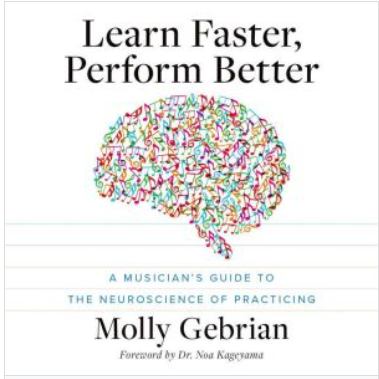
What Learn Faster, Perform Better by Molly Gebrian Taught Me About Practicing Smarter
Most of us were taught that getting better at something—music, writing, any craft—comes down to one simple rule:
Put in more hours.
While time absolutely matters, Molly Gebrian’s Learn Faster, Perform Better makes a compelling case that how you practice is often more important than how long you practice.
One of my goals for this year is to make the most out of the time I have for practicing and writing. So I have been on the lookout for books like this, and this one delivers.
The book dives into neuroscience and learning research, but in a way that’s accessible and immediately useful.
Here are some of the key ideas from the book—and why they matter.
Practice Physically Changes Your Brain
One of the foundational concepts in Learn Faster, Perform Better is neuroplasticity: the brain’s ability to change based on experience.
Every time you practice a skill, you’re strengthening specific neural pathways. Over time, those pathways become faster and more automatic. This means practice isn’t just “getting reps”—it’s reshaping your brain.
The important implication:
- Sloppy, unfocused practice strengthens sloppy, unfocused pathways.
- Focused, intentional practice builds clean, reliable ones.
This one has really hit home for me. I spent years just playing along to jam tracks as practice, not focusing on anything in particular—and I can hear that in my playing. Sloppy licks here or there, missing a beat… these things add up.
More Hours Isn’t Always Better
Gebrian challenges the idea that long, exhausting practice sessions are the gold standard.
Research shows that:
- Shorter, focused sessions often beat marathon sessions
- Taking breaks helps consolidate learning
- Sleep plays a major role in locking in new skills
Your brain continues processing what you practiced after you stop. That means spacing your practice across days and allowing rest can lead to better retention than cramming everything into one giant session.
You don’t grow while you’re practicing. You grow while you’re recovering.
Consistency over time beats intensity in short bursts.
I’ve said this before: consistency is key—just as it is in fitness, it’s key here too. You don’t get better from one long great practice session. You get better from smaller, consistent practice sessions over time.
Work on Different Sections of the Same Piece
One of the big takeaways I got from the book was to work on different sections of the same piece.
Set a timer for 5 minutes and focus on one section. Then move to a different section of the song for another 5 minutes.
My example:
I wanted to learn Stray Cat Strut by the Stray Cats. Instead of running the solo over and over for an hour and a half in one session, I did this:
- 5 minutes on a few bars of the solo
- 5 minutes on singing and playing the song
- Back and forth
I did this for about 30 minutes, three times a week. I learned both parts of the song faster and remembered the solo much more easily than with my normal marathon practice sessions.
Here is one recorded version of the solo (not perfect, but getting there):
Deliberate Practice Beats Mindless Repetition
One of the biggest shifts this book encourages is moving from passive repetition to deliberate practice.
Passive practice looks like:
- Playing something top to bottom
- Hoping it magically improves
- Avoiding difficult sections
Deliberate practice looks like:
- Identifying specific problems
- Isolating small sections
- Testing solutions
- Adjusting based on results
Instead of asking, “How many times did I play this?”
Ask, “What problem did I solve today?”
This year I’ve been focusing my practice. Each session has intent behind it. I’m also keeping a music journal to track what needs work and what I’m currently focusing on. I’m already seeing changes.
I also record myself and listen back to find troublesome sections so I can focus on them instead of just playing the easy stuff because it feels good.
Mental Practice Is Real Practice
You don’t always need your instrument to improve.
I think of this as deep listening. I’ll play a song I’m working on while driving and really listen to the rhythm, the groove, and how each instrument interacts. What is the rhythm section doing? What is the guitar player playing? I even imagine where their hands are.
This helps tremendously when I go back to work on the piece.
Mental practice activates many of the same brain areas as physical practice. When done correctly, it can:
- Strengthen memory
- Improve accuracy
- Reinforce motor patterns
The key is vividness. Don’t just “think about” the music. Hear it clearly in your mind. Feel the motions.
Don’t Rely on Muscle Memory Alone
Muscle memory feels great… until it fails under pressure.
Gebrian emphasizes building multiple memory systems, including:
- Auditory memory (how it sounds)
- Visual memory (what it looks like)
- Analytical memory (understanding structure)
- Motor memory (physical movement)
When one system wobbles, the others can save you.
I know you’ve seen performers who are completely engulfed in what they’re playing—body and instrument moving as one.
You’ve probably also seen performers stiff as a board, terror in their eyes. I’ve been there too. One mistake becomes two, then three, and suddenly your mind is telling you you’re the worst musician alive.
Rarely will you be booed off stage. But having tools to recover from those thoughts is also a form of practice.
Make Practice Harder Than Performance
This idea feels backwards at first.
Why make practice harder?
Because performance is unpredictable.
Gebrian suggests adding variation:
- Change tempos
- Start in different places
- Mix pieces
- Add small distractions
These force your brain to retrieve information rather than run on autopilot.
Retrieval strengthens memory.
I try to recreate performance settings whenever I can—open mics, setting up my room like a live show, or recording myself. It always makes me feel more prepared.
Mistakes Are Data, Not Failure
Mistakes aren’t proof you’re bad. They’re proof you’ve found the edge of your ability.
- What specifically went wrong?
- Why did it happen?
- What’s a small adjustment I can test?
Curiosity beats self-criticism.
This mindset turns practice into problem-solving instead of punishment.
What This Means Beyond Music
Although the book is written for musicians, these ideas apply to any creative discipline:
- Writers drafting messy pages
- Artists sketching rough studies
- Songwriters building unfinished ideas
Learning happens through small steps, repeated often, with attention and consistency.
The Bigger Lesson
Learn Faster, Perform Better isn’t about shortcuts.
It’s about alignment—and finding what works for you.
When your habits align with how your brain actually learns, progress becomes steadier, less frustrating, and more sustainable.
You still have to show up. You still have to do the work.
But you don’t have to waste energy doing it the hard way.